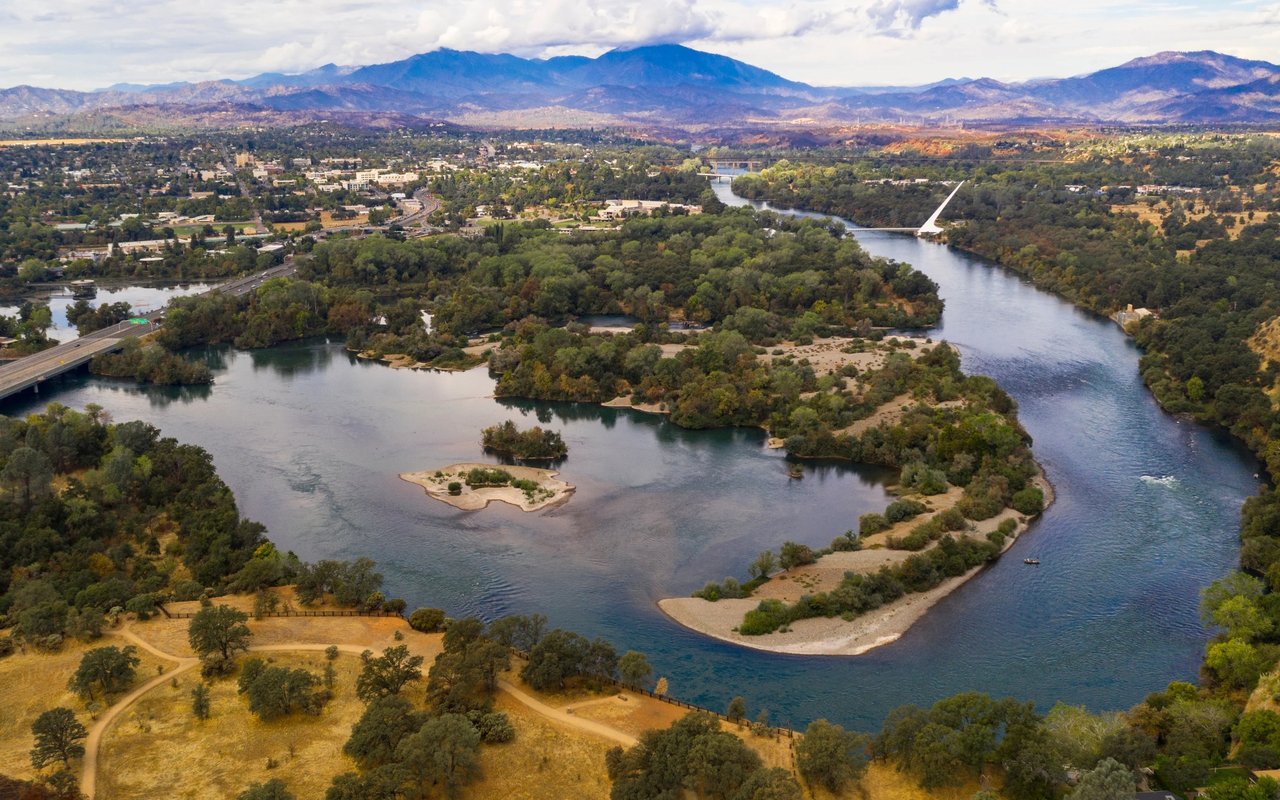
Sits at the northern end of California's Sacramento Valley, where the Sacramento River passes through a city surrounded by foothills, forests, and mountain scenery. As the largest city in Shasta County, Redding serves as a regional center for healthcare, education, shopping, employment, and recreation.
The city's development has long been connected to transportation, agriculture, and the surrounding region's natural resources. Today, Redding combines an established downtown, traditional residential neighborhoods, newer subdivisions, and properties with larger lots along the edges of the city.
One of Redding's defining features is access to outdoor recreation. The Sacramento River runs through the community, the Sundial Bridge connects visitors to the Turtle Bay area and river trails, and nearby destinations include Whiskeytown National Recreation Area and Shasta Lake.
Redding also offers a range of residential settings. You can find older homes near downtown, suburban properties with conventional lots, custom homes in hillside neighborhoods, and larger residential parcels in select areas.
For buyers considering Northern California, Redding provides an opportunity to compare different housing types, neighborhood settings, and ownership costs within one regional market.
Redding is located in Shasta County in Northern California, along Interstate 5. It serves as a major commercial and transportation center for the northern Sacramento Valley and surrounding communities.
Interstate 5 provides north-south access toward Sacramento and Oregon. State Route 299 connects Redding with communities to the east and west, while State Route 44 provides an additional eastward connection.
Nearby communities include Shasta Lake, Anderson, Palo Cedro, Bella Vista, and Cottonwood. Some properties marketed with a Redding mailing address are outside the incorporated city limits, so buyers should verify jurisdiction, utilities, and applicable property regulations.
Redding Municipal Airport provides regional air transportation, while downtown Redding has an Amtrak station.
Redding real estate offers a variety of property types, architectural styles, and lot configurations. Housing options range from established single-family homes to newer developments, custom properties, condominiums, and multifamily buildings.
Central Redding and several surrounding neighborhoods contain homes built across multiple decades. Ranch-style homes, traditional single-story properties, and other established residential designs are common in many areas.
Buyers considering older homes should pay attention to roofing, HVAC systems, insulation, electrical systems, plumbing, and previous renovations. Redding's hot summers also make cooling efficiency and shade important considerations.
Newer residential development can be found in various parts of Redding, including eastern and northern areas of the city. Depending on the development, homes may offer open floor plans, contemporary finishes, attached garages, and modern building systems.
Buyers should compare construction quality, lot size, landscaping, HOA obligations, and ongoing maintenance costs rather than relying on the home's age alone.
Certain residential areas feature custom-built homes, larger lots, hillside settings, and properties with additional outdoor space.
Larger parcels may introduce considerations involving drainage, grading, retaining walls, defensible space, irrigation, and landscape maintenance. Some properties outside city limits may also use private wells or septic systems.
The right property depends on your budget, preferred location, maintenance expectations, and long-term ownership plans.
Redding includes a variety of established neighborhoods and named residential developments. These are some of the areas buyers commonly research.
Country Oaks is an established residential subdivision in northeastern Redding. Buyers can compare its single-family homes, lot configurations, property condition, and access to nearby roads and services.
Mary Lake is a residential area in western Redding associated with its namesake lake and surrounding neighborhoods. Homes vary by street and development, making property-specific comparisons important.
Gold Hills is a residential golf community in northeastern Redding. Buyers interested in the area should review individual lot characteristics, golf-course proximity, and any applicable association requirements.
Tierra Oaks is a golf-oriented residential community in northern Redding known for custom-home properties. Buyers should verify current community rules, membership arrangements, and property-specific obligations.
Garden Tract is an established residential neighborhood near central Redding. Its location and older housing stock make it worth considering for buyers interested in existing homes and renovation opportunities.
The Lake Redding area is associated with the Sacramento River corridor and nearby recreational amenities. Housing options and property characteristics differ across its residential streets.
Sunset Terrace is an established residential area in western Redding. Buyers can evaluate its location, home styles, and proximity to other west Redding amenities.
Shastina Ranch is a named residential development in Redding. Buyers should compare floor plans, lot sizes, property condition, and any development-specific requirements.
Neighborhood names do not always correspond to official municipal boundaries. Buyers should verify the location of individual properties and applicable subdivision restrictions.
Outdoor recreation is a major part of Redding's appeal. The city offers parks, trails, river access, and connections to recreation destinations throughout Shasta County.
The Sacramento River Trail is one of Redding's signature recreational amenities. Its paved sections support walking, running, and cycling, with views of the Sacramento River and access to connected trail systems.
The Sundial Bridge is a pedestrian bridge across the Sacramento River and a recognizable Redding landmark. It connects to the Turtle Bay area, where visitors can access trails, gardens, and educational attractions.
Located west of Redding, Whiskeytown National Recreation Area offers a lake, hiking trails, waterfalls, and outdoor recreation. Access, trail conditions, and recreation restrictions can change, so visitors should check National Park Service information before visiting.
Shasta Lake is located north of Redding and provides opportunities for boating, fishing, and other water activities. Lake levels, boat-launch availability, and seasonal conditions vary.
Redding maintains a network of public parks and recreational facilities. Caldwell Park, Enterprise Park, and other public spaces provide access to activities that may include walking, sports, playgrounds, and community recreation.
The range of outdoor activities is an advantage for residents who want access to both city amenities and regional recreation.
Redding serves as a shopping and service center for much of Shasta County.
Downtown Redding includes restaurants, local businesses, entertainment venues, and civic destinations. Market Street and surrounding streets form part of the downtown commercial area.
The Mount Shasta Mall area and nearby commercial corridors offer additional shopping, dining, and retail services. Other commercial districts along major roads provide grocery stores, everyday services, and neighborhood businesses.
Redding also has healthcare facilities, professional services, libraries, and community institutions serving the broader region.
When comparing neighborhoods, consider how often you expect to travel to grocery stores, healthcare appointments, employment centers, and recreational facilities. A home's location within Redding can affect your daily driving patterns.
Redding is served by multiple public school districts. Elementary and middle school assignments depend on the property's location and district boundaries.
Districts serving portions of the Redding area include Redding School District, Enterprise Elementary School District, Columbia Elementary School District, and Gateway Unified School District.
Shasta Union High School District serves many area high school students, with campuses including Shasta High School and Enterprise High School. Other public, charter, and private educational options are available throughout the region.
For higher education, Shasta College serves the area, and Simpson University is located in Redding.
School attendance boundaries and enrollment policies may change. Buyers should confirm school assignments directly with the appropriate district.
Buying a home in Redding involves evaluating the property itself and the conditions that affect long-term ownership.
Start by comparing homes within the same neighborhood or market segment. Construction age, floor plan, lot size, upgrades, and property condition can influence value.
Redding's climate makes roofing, air conditioning, insulation, ventilation, and landscaping important inspection considerations. Buyers should also review drainage, grading, and the condition of outdoor improvements.
Wildfire exposure and insurance availability deserve attention, particularly for properties near open land or foothills. Some properties may also require flood-risk review. These conditions must be evaluated at the individual property level.
For homes outside city limits, confirm utility providers, water sources, wastewater systems, zoning, and maintenance responsibilities.
A thorough property evaluation can help you understand the purchase price and the expenses associated with owning the home.
Selling your Redding home starts with understanding how buyers compare properties in your neighborhood.
An effective pricing strategy considers recent comparable sales, active competition, property condition, lot characteristics, and the features buyers value in that market segment.
A custom home on a larger parcel should not automatically be priced using the same approach as a smaller production-built home. Likewise, substantial renovations may affect marketability, but their cost does not always translate directly into resale value.
Before listing, consider which repairs, maintenance items, and presentation improvements are likely to help buyers evaluate the property.
Charlie Brown combines real estate valuation with construction and renovation knowledge to help sellers assess property condition, prepare for the market, and develop a pricing and marketing strategy.
The objective is to make informed decisions based on the property's characteristics and current market conditions.
Redding offers several residential property categories for investors to evaluate, including single-family rentals, smaller multifamily properties, and homes with potential renovation opportunities.
An investment analysis should begin with acquisition costs, realistic rental income, vacancy assumptions, operating expenses, property taxes, insurance, and expected maintenance.
For renovation projects, construction costs and the property's resale or rental potential should be evaluated together. Investors should also review zoning, rental regulations, and any restrictions affecting the intended use.
Properties with larger lots or additional structures may present opportunities, but buyers should verify permitted uses and development feasibility before assigning value to those possibilities.
Charlie Brown helps investors examine property fundamentals and develop long-term ownership strategies focused on risk, cash flow, and wealth-building.
Redding is located in Shasta County at the northern end of the Sacramento Valley. Interstate 5 runs through the city, providing access toward Sacramento and Oregon. Redding is also connected to surrounding Northern California communities by State Routes 44 and 299.
Redding offers established single-family homes, newer residential developments, custom homes, condominiums, and multifamily properties. Some areas feature larger lots and hillside settings. Available property types and prices vary by neighborhood, condition, and current inventory.
Residential areas include Country Oaks, Mary Lake, Gold Hills, Tierra Oaks, Garden Tract, Lake Redding, Sunset Terrace, and Shastina Ranch. Each has different property characteristics and location considerations. Some neighborhood names are informal or subdivision-specific rather than official city planning districts.
Redding offers access to the Sacramento River Trail, Sundial Bridge, Turtle Bay, and numerous city parks. Whiskeytown National Recreation Area lies west of the city, while Shasta Lake is north of Redding. Activities include walking, cycling, hiking, fishing, and boating, subject to seasonal conditions.
Several districts serve different parts of Redding, including Redding School District, Enterprise Elementary School District, and Shasta Union High School District. Other districts also serve portions of the area. School assignments depend on the property's address and should be confirmed with the appropriate district.
Homebuyers should investigate homeowners insurance availability, premiums, and coverage terms early in the purchase process. Wildfire exposure varies by property location, and flood conditions may also require review. Buyers should obtain property-specific insurance quotes rather than relying on general neighborhood descriptions.
You can search current Redding listings through a real estate website connected to the local MLS. Filtering by neighborhood, price, property type, lot size, and other features can help narrow the options. A local agent can also help you evaluate comparable sales and property conditions.
A home's market value depends on recent comparable sales, location, size, condition, upgrades, lot characteristics, and current competition. An automated estimate can provide a starting point, but a property-specific comparative market analysis offers a more detailed evaluation of how your home compares with recent sales.
Buying, selling, or investing in Redding real estate involves decisions that can affect your finances for years.
Charlie Brown is a Northern California Realtor and real estate investment advisor who combines residential real estate guidance with construction management and renovation knowledge.
If you're purchasing a home, Charlie can help you evaluate property condition, compare neighborhoods, and assess ownership costs. If you're selling, he can help you develop a pricing and preparation strategy based on comparable properties and current market conditions.
For investors, his approach emphasizes property fundamentals, financial analysis, and long-term ownership.
Contact Charlie Brown to discuss your Redding real estate goals and identify your next steps.
112,523 people live in Redding, where the median age is 40.2 and the average individual income is $39,581. Data provided by the U.S. Census Bureau.
Total Population
Median Age
Population Density Population Density This is the number of people per square mile in a neighborhood.
Average individual Income
There's plenty to do around Redding, including shopping, dining, nightlife, parks, and more. Data provided by Walk Score and Yelp.
Explore popular things to do in the area, including Krispy Krunchy Chicken.
Redding has 44,018 households, with an average household size of 2.4966666666666666. Data provided by the U.S. Census Bureau. Here’s what the people living in Redding do for work — and how long it takes them to get there. Data provided by the U.S. Census Bureau. 112,523 people call Redding home. The population density is 634 and the largest age group is Data provided by the U.S. Census Bureau.
Total Population
Population Density Population Density This is the number of people per square mile in a neighborhood.
Median Age
Men vs Women
Population by Age Group
0-9 Years
10-17 Years
18-24 Years
25-64 Years
65-74 Years
75+ Years
Education Level
Total Households
Average Household Size
Average individual Income
Households with Children
With Children:
Without Children:
Marital Status
Blue vs White Collar Workers
Blue Collar:
White Collar: